
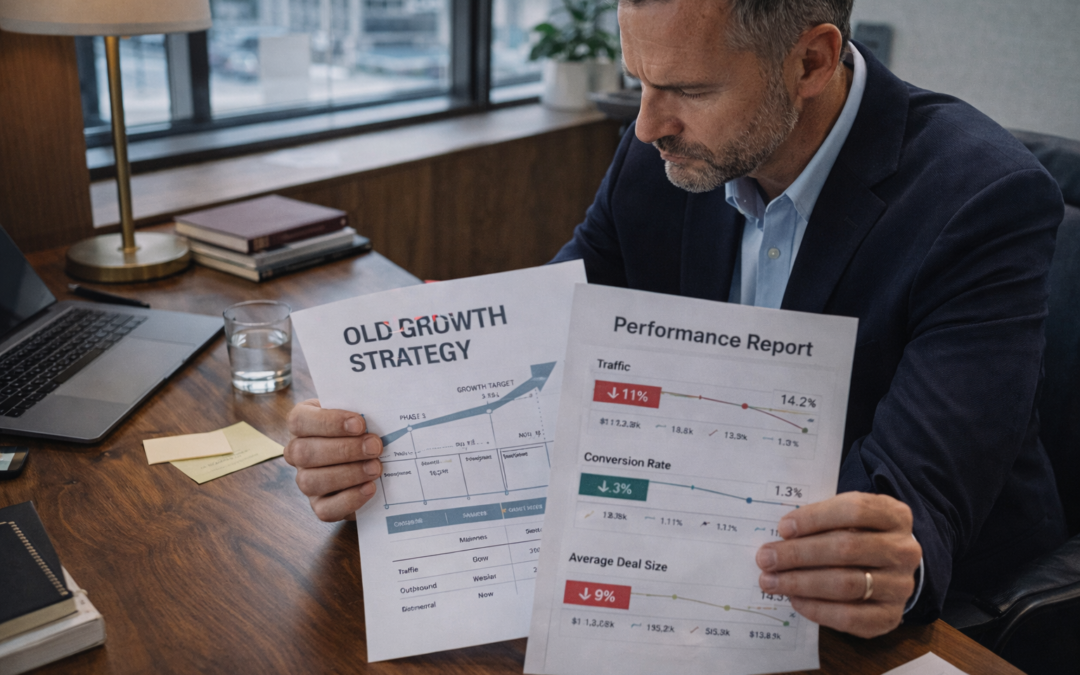
Introduction
A lot of businesses assume that if a strategy helped them grow once, it should keep working.
That assumption makes sense.
The business grew.
Revenue increased.
Customers came in.
The team figured out what worked.
The market responded.
So leadership keeps pushing the same model.
More of the same channels.
More of the same message.
More of the same sales process.
More of the same offer structure.
More of the same operating habits.
And then growth slows down.
That is where a lot of companies get stuck.
Because the strategy that helped the business get here can become the thing that keeps it from getting further.
Growth Strategies Expire Faster Than Most Companies Admit
Most growth strategies are built for a specific stage of the business.
They fit a certain size.
A certain market position.
A certain level of complexity.
A certain offer mix.
A certain sales motion.
A certain buyer context.
When the business changes, that original strategy often fits less well.
But leadership does not always see it right away.
The business still has some momentum.
The old playbook still produces some results.
The team still trusts what worked before.
So the company keeps repeating a strategy that is becoming less effective.
That usually does not break growth overnight.
It gradually reduces efficiency until leadership feels that growth is getting harder than it should be.
Why Businesses Outgrow the Growth Strategy That Got Them Here
1. The Market Changes, but the Strategy Stays the Same
The simplest reason growth strategies expire is that the market changes.
Buyer priorities shift.
Competitors reposition.
Channels evolve.
Expectations increase.
Pricing pressure changes.
The category becomes more crowded.
But a lot of businesses keep operating as if the conditions that supported earlier growth still exist.
That creates drift.
The same message starts landing less strongly.
The same channels become less efficient.
The same sales motion creates less urgency.
The same offer feels less differentiated.
This is one reason growth begins to break even when leadership is still “doing what worked.” The strategy may not be failing because it was bad. It may be failing because the market moved. That is the same pattern behind why growth breaks when the offer stops matching the market.
2. The Business Gets More Complex, but the Operating Model Does Not Mature
What works at one stage of growth often depends on simplicity.
The founder is close to everything.
Decision-making is fast.
The offer is narrow.
The team is small.
Sales and marketing are informal but manageable.
As the business grows, complexity increases.
More people get involved.
More handoffs appear.
More offers exist.
More coordination is required.
More structure becomes necessary.
If the operating model does not mature with that complexity, the old strategy starts producing friction instead of growth.
That is often when businesses feel overloaded without feeling stronger. There is more activity, more people, and more moving parts, but not enough improvement in throughput. That is one reason a business can stay busy without actually growing.
3. Early Growth Was Driven by One Lever That No Longer Carries the Business
Many companies grow through one dominant lever.
A founder’s network.
A referral base.
A strong paid channel.
A specific SEO advantage.
A standout offer.
A simple outbound motion.
That can work extremely well for a period of time.
But as the business grows, that lever often becomes less sufficient by itself.
The company needs a broader system.
Stronger positioning.
Better conversion.
A more mature sales process.
Better alignment across functions.
If leadership keeps trying to scale the same single lever beyond its natural strength, growth starts to flatten.
This is especially common when businesses keep trying to solve every problem with more top-of-funnel activity. But once the business reaches a certain stage, growth usually depends less on raw input and more on the strength of the whole system. That is why more leads will not fix a broken revenue system.
4. The Sales Motion No Longer Matches the Business You Are Now
A company can also outgrow its sales process.
What worked when deals were smaller, faster, or more founder-led may stop working when the business needs larger, more structured, more repeatable revenue.
The old sales motion may rely too much on:
- founder instinct
- informal qualification
- reactive follow-up
- unclear proposals
- unstructured forecasting
- heroics instead of process
That can work for a while.
But as growth expectations rise, the lack of a stronger process starts limiting conversion and predictability.
This is one reason companies hit a ceiling even while demand still exists. The system that converts opportunity into revenue did not mature at the same pace as the business. That is the issue behind why good marketing cannot save a bad sales process.
5. The Metrics That Once Felt Good Are No Longer Good Enough
Earlier-stage growth often feels strong with simpler metrics.
More traffic.
More leads.
More calls.
More pipeline.
More visible activity.
But as the business matures, those metrics become less useful on their own.
Leadership needs better visibility into:
- lead quality
- conversion rate by stage
- sales velocity
- close rate
- average deal size
- margin quality
- operational friction
- revenue consistency
If the business keeps managing itself with early-stage metrics, it can miss the fact that the old strategy is becoming inefficient.
That is why mature growth usually requires better diagnostic visibility, not just more reporting. This is the same issue behind the metrics that matter when growth has stalled.
6. The Business Keeps Optimizing the Old Model Instead of Rethinking It
This is where many companies lose time.
They sense growth is harder.
So they try to squeeze more out of the current model.
They tweak messaging.
They refresh the website.
They increase ad spend.
They push sales harder.
They run more campaigns.
Those moves are not always wrong.
But sometimes the deeper issue is that the growth model itself needs to evolve.
If the business has truly outgrown the strategy that got it here, optimizing the old model only delays the harder but more useful work:
Rebuilding the strategy around the company you are now and the market you are now serving.
Sometimes the issue isn’t more demand — it’s that the system hasn’t evolved. In this case, fixing a broken buying flow restored performance across all channels without increasing traffic: https://www.dimostra.com/results-ecommerce-conversion-case-study/
Signs You May Have Outgrown Your Current Growth Strategy
There are a few common signs this is happening:
- growth feels harder even though effort has increased
- channels that used to work well now produce weaker returns
- the team stays busy, but throughput feels weak
- the pipeline is active, but revenue conversion is soft
- the offer still gets attention, but urgency feels weaker
- leadership keeps revisiting the same fixes without real improvement
- the business relies too heavily on founder intuition or a single channel
- complexity has increased faster than process maturity
None of those proves the old strategy is dead.
But together, they usually indicate the business is no longer operating from a growth model that fits its current stage.
Why This Problem Gets Misdiagnosed
This problem is easy to misdiagnose because the old strategy usually still works a little.
That creates confusion.
Leadership sees some results and concludes:
- we just need to execute better
- we need more volume
- sales needs more pressure
- marketing needs to work harder
- the market is just temporarily slower
Sometimes those explanations are partly true.
But they often miss the bigger issue:
The business may be trying to scale a model built for an earlier stage.
That is why some companies keep trying to fix symptoms instead of stepping back to identify the real constraint. The issue may not be one broken tactic. It may be that the growth model itself is no longer aligned with the business. That is exactly why it helps to assess how to find the bottleneck that is limiting revenue.
What to Look At Instead
If you think the business may have outgrown its current growth strategy, review:
- which channels are truly driving qualified revenue now
- whether the offer still lands with the right buyers
- whether conversion has weakened at key stages
- whether sales process maturity matches deal complexity
- whether operational structure supports the current level of growth
- whether the business depends too heavily on one growth lever
- whether old metrics are masking deeper inefficiency
- where throughput has weakened compared to earlier periods
Those questions help you determine whether the issue is execution inside the current strategy or misfit between the current strategy and the current stage of the business.
The Better Question
A lot of leadership teams ask:
How do we make this strategy work better?
That may not be the right first question.
A better question is:
Has the business outgrown the strategy that got it here?
That question forces the company to look honestly at whether the old model still fits the current market, team, offer, and revenue goals.
Sometimes it does.
Sometimes it needs to evolve.
And that distinction matters more than most companies realize.
Revenue Constraint Diagnosis
If growth has slowed, the issue may not be effort alone.
A Revenue Constraint Diagnosis helps identify whether the real bottleneck is an outdated growth model, traffic quality, conversion, sales execution, offer alignment, or another constraint inside the revenue system so you can fix what is actually limiting growth.
If you want to know whether the business has outgrown the strategy that got it here, start with a Revenue Constraint Diagnosis.